
A patio ought to be an outdoor place for resting. However, once water accumulates beneath it, the area becomes sloppy, muddy and unsuitable. Moreover, you also ruin your pavers, concrete, or deck boards in time due to poor drainage.
The good news? You do not necessarily have to construct your entire patio in order to rectify the issue. The right steps can help you to improve drainage, safeguard your investment, as well as regain your comfort outdoors.
Let’s unfold some of the most basic yet effective methods of improving patio drainage, which do not involve dismantling everything.
Why Good Drainage Matters
Water may not be the problem, but when it remains beneath your patio, it may cause big trouble. It leaks through the soil, deteriorates substances and promotes moulds.
You can observe sinking paving, tiles, or a stale smell. The foundation also turns unstable over time. So, basically, good drainage ensures that your patio is flat, safe and durable. It also eliminates muddy spots, mosquitoes and slippery floors. Today, a few modifications can save you the costly repairs in the future.
1) Find out How the Water Gets There.
It is good to first note the area after or during rain. From where does the water get in there? Which direction does it flow? Is it your yard or the roof of the patio?
This is the step that will assist you in selecting the appropriate solution. It is not necessarily the patio that causes the problem, but the adjacent landscape or downspouts. A small investigation will help you fix the actual source of the problem.
2) Clean Off Spots and Eliminate Rubbish
Cleaning is a very easy solution; however, it is sadly always neglected.
The small spaces between the patio stones or pavers are filled with dirt, leaves, moss and mud. Whenever these openings are sealed, water has nowhere to pass. Resultantly, the water remains underneath the surface.
So what must you do? Wipe up using a hard brush or pressure washer. Ensure that the joints are open and have airways. This little activity can considerably enhance the flow of water.
3) Refill Joints using the Right Material
After cleaning the gaps, fill them with new jointing sand or polymeric sand. The materials allow the water to pass through rather than it being trapped. Furthermore, the polymeric sand becomes a little hard thus deterring weeds and erosion.
But it still allows water to drain down naturally. This would be very helpful with patios that are made of brick, stone or concrete pavers.
In case your patio has loose joints or no sand, filling them will recreate the original drainage design.
4) Insert a Simple French Drain along the Edges
One of the ways to ensure that the water does not soak your patio is to drain it away using a French drain, and not touching the patio surface at all.
It is a shallow trench that is lined with landscaping fabric, gravel-filled and equipped with a perforated pipe. The pipe collects water and directs it to a secure place, such as a garden bed or drainage pit.
This is done by installing the French drain on the lower portion of your patio, where the water will collect. This solution remains quite hidden, works silently and also minimizes water accumulation under the building.
5) Try Improving the Slope of your Patio
It is possible that your patio is all right, and the ground around it is channeling water to it instead of letting it run out. This is highly prevalent, particularly in older landscapes.
To repair the slope, add soil to achieve a low gradient downwards slope that will drain the water. Even a minor change can create a huge difference. Plants or mulch cover the soil to help keep it in place. Moreover, it is a cheap technique, and it will not disrupt your patio area.
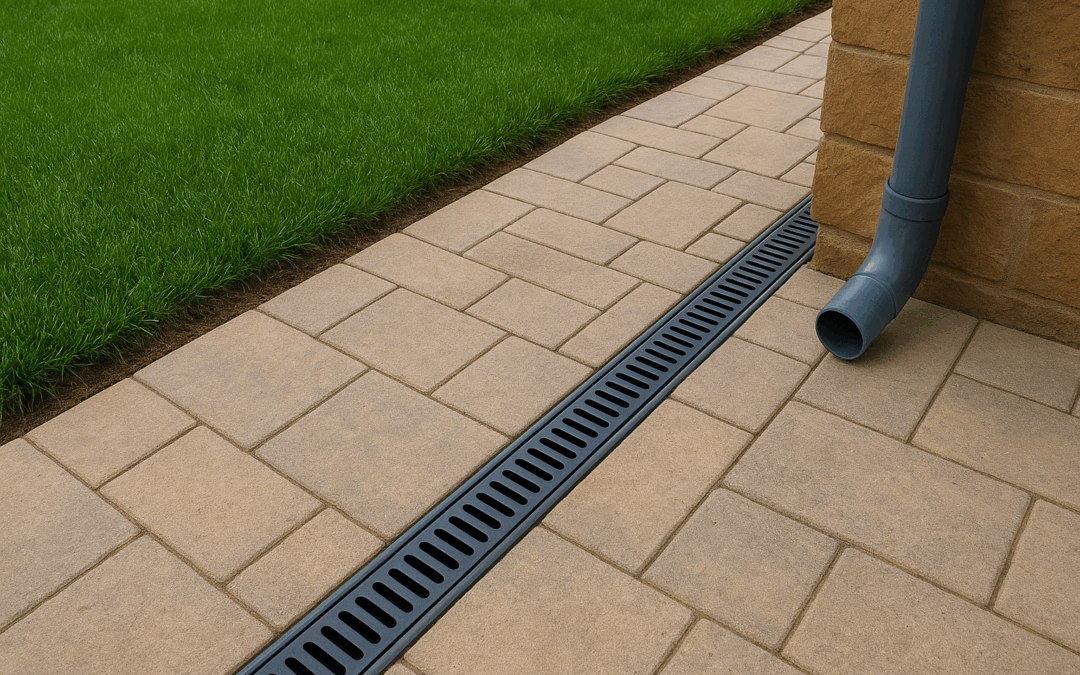
6) Install a Channel Drain
When your patio is fed by your driveway, swimming pool or walkway, then a channel drain can collect the water before it infiltrates.
Also, a channel drain is a long, narrow grate which is placed on the edge of the patio. It gathers water and channels it into a drainage pipe that is underground. This ensures that there is no stagnant water around the foundation and thus it avoids flooding during heavy rains.
Further, it does not need any rebuilding of the patio, but small cutting or edging work is involved.
7) Redirect Your Downspouts
One of the most common reasons for patio drainage issues is roof runoff. When it rains and the water runs directly off the gutters on your patio, this saturates the ground.
Install downspout extensions to push water further into the yard. The downspout can also be attached to drainage pipe or rain barrel.
This minor modification ensures the safety of your patio area and it will not allow water to accumulate beneath it.
8) Use Permeable Add-Ons
In case your patio space is concrete and not highly permeable, one can think about placing drainage-friendly features in the area.
9) Some helpful ideas include:
- Gravel borders
- River rock beds
- Permeable paver strips
- Decorative stone channels
These substances permit water to seep into the ground on its own. Additionally, they are very nice to look at, and they can be mixed with any patio design. Also, they relieve the tension on the patio itself.
9) Lift and Re-level Only the Problem Areas.
You do not have to reconstruct the whole patio in case your pavers are sinking or are uneven. It is possible to lift only the affected part, make the base flat, and resume the pavers.
Before the stones are put back, add a layer of gravel or sand to enhance their drainage. This method reinstates the structure of the patio with the rest left intact. The best part? It is a cheap and less disruptive option.
When to Call a Professional
Small drainage fixes are not complex to deal with. However, when you notice some big sinking, continuous flooding, or moulding in the patio, then it is time to call an expert such as Decks N’ Stones.
They are able to determine the groundwork, state of the soil and inclination correctly. One of the Decks N’ Stones specialists will be able to select the most suitable long-term solution and enhance drainage without unjustified reconstruction.
Key Takeaways
You do not have to reconstruct your patio to alleviate the drainage issues. Simply by applying the correct approach, smart cleaning between the cracks, introducing drains, enhancing slope, or channelling water, you can save your outdoor space.
A patio that has been well drained is solid, dry and beautiful over a period of years. And these basic improvements will help you to prolong its lifespan and make your backyard cozy and welcoming again.