
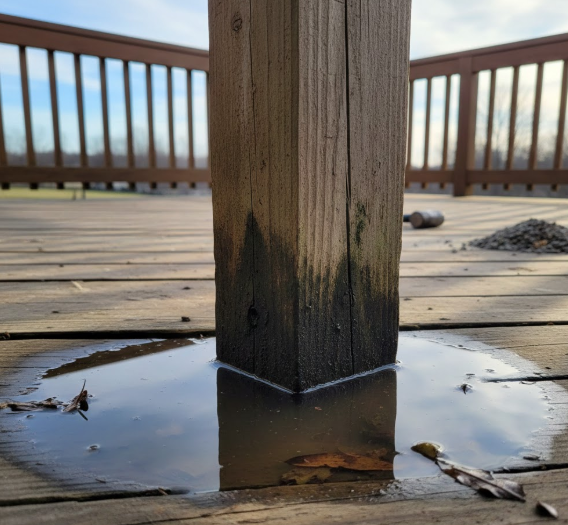
That innocent-looking puddle is worse than a nuisance. Uncontrolled, ponding of water at deck posts may silently rot wood, compromise footings, and cost your deck years of life.
But, don’t worry!
This is a problem that can be fixed and you do not have to be a structural engineer to know this.
We will deconstruct the reasons behind this and how it can be corrected the proper way.
Why Pooling of Water around Deck Posts is a Big Issue?
Deck posts are supporting structures. The consistent accumulation of water at their base causes water to percolate into the soil and the wood thus forming an ideal place where rot, mould and sinking foundations thrive. In the long run, this dampness may undermine the structural integrity of your whole deck.
Standing water, in colder climates, is worse still. This is because it freezes, heaves, works soil about, tilts or heaves posts. What begins as a puddle may become the patchy rails or sounding boards or even more of a trouble.
Typical Reasons causing Water Pooling between Deck posts
Before attempting to fix the problem, it is always good to understand the source of the problem.
Inadequate Grading around the Deck.
When the ground in your surrounding deck is facing toward the posts rather than out, then the rain water will naturally accumulate there. This is among the most prevalent culprits.
Compacted or Clay-Heavy Soil
Compact soil does not absorb water easily. Water does not sink away but hangs on the surface– right in the middle of your posts.
Improper Footing Excavation.
Deck posts installed without gravel foundations or proper clearance between them to allow drainage are more likely to collect water.
Downspout Runoff
At other times, it is not even the deck. Downspouts or gutters releasing water in areas close to deck posts may flood the area during heavy rain.
Fixing Pooling Water at Deck Posts.
And now, the practical part, presenting solutions that work.
So first of all,
Improve Ground Grading
The easiest and sometimes the best remedy is to regrade the soil surrounding your deck. Posts should be sloped down the ground at least by a few inches over a few feet. This promotes the natural flow of water rather than its accumulation at the bottom.
Add a Gravel Drainage Layer
Dig a small hole around each of the posts and place the crushed stone or gravel. Gravel enhances drainage because it enables the water to flow down rather than lie on the surface. This works well with effective grading.
Install a French Drain
A French drain may be a life-changer when it comes to a stubborn water problem. This will entail laying a perforated pipe in the area of gravel to divert water in the deck area. It is a permanent fix to the problematic yards in terms of drainage.
Redirect Downspouts
Make sure that your gutter downflow outlets discharge water. In case they are shedding rainwater on deck posts, some should be stretched out to make the water flow several feet off deck.
Use Post Base Hardware
To avoid direct wood-to-water contact, deck posts are raised just above the concrete footing with metal post bases. This does not remove the pooling water, but it drastically does away with the moisture destruction on the posts.
Preventing Future Water Problems Around Your Deck.
After the problem has been resolved, a minor precaution is quite sufficient.
Check the surroundings of deck posts regularly after heavy rain.
Do not allow soil and mulch to accumulate around posts.
Plants with too much water demand should not be placed too close to the deck.
Make gutters and drains clear and operational.
Regular inspections would prevent you expensive structural repairs in the future.
When to Call the Professionals
When water ponding continues to recur or when you are observing rotting wood, stooped posts, or footing cracks, it is high time to call the professionals.
By ensuring your deck remains solid over the years, professional deck builders such as Decks N’ Stones can evaluate the drainage, the depth of the footing and structural security.
We believe that a good deck is not only a matter of appearance but rather a matter of durability, stability, and intelligent design decisions. A dry deck is a happy deck.
Fix the puddles now, and your future self (and your deck) will thank you.