
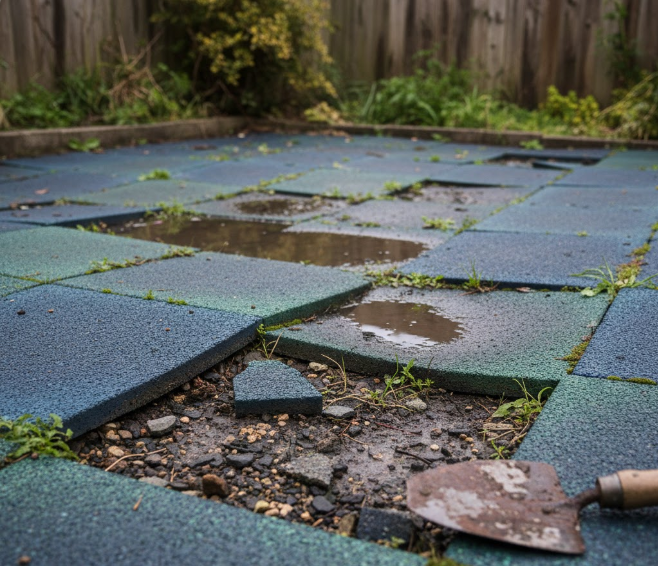
When you get out of your patio, it should be rock-solid. When, on the contrary, it is soft, springy, or unsymmetrical below your feet, there is something wrong under the surface. Being not only uncomfortable a spongy patio can also be indicative of a more serious structural issue that could get worse in the long run without treatment.
The initial step towards correcting this situation is understanding the reasons as to why this occurs and how to ensure that your outdoor space is safe.
Why does a Patio Feel Spongy?
The issue is, in most cases, not these pavers or stones you are looking at, but the foundation under them. The patio is supported by a powerful and compacted surface to carry the weight evenly. Once that bottom becomes weak, the surface starts moving and bending.
Poor base preparation during installation is one of the common causes. Unless the soil is dug and hardened sufficiently, it may not be able to support normal foot traffic, notwithstanding its tendency to settle at uneven levels. This eventually forms soft spots that are not stable when one walks on them.
Another significant source is water. Unless drainage was done properly, the base layers may leak due to rain, irrigation or melting snow. Wet soils become incapable of supporting weight, which makes them spongy. This can even get worse than in colder climates, where the freeze-thaw cycles expand and contract the soil underneath your patio.
Erosion also plays a role. Water under or around the patio may erode supporting material over time. This will result in space under the surface, which makes the pavers to sink or bounce when pressure acts on them.
The Costs of Overlooking the Problem.
A patio that is spongy is hardly a cosmetic problem. With the further weakening of the base, the pavers can crack, sink, or become misaligned. It can not only influence the look of your patio but can also result in tripping. In extreme cases, some areas of the patio might have to be fully reconstructed in case the damage expands.
It is always better to deal with the problem in the initial stages before making larger repairs. The faster the base is stabilized, the simpler and cheaper the remedy tends to be.
How to Find the Underlying Issue.
Before correcting the issue, find out its root cause. Go through the patio and observe where the softness is to be found. Localised softness is frequently a sign of erosion or spaces under certain regions, and general sponginess is a sign of general failure at the base or inadequate compaction.
Check whether there is water pooling at the edges or joints of the patio. This could indicate drainage problems, which should be remedied. Also, investigate whether the patio is sloping away as it should be. Failure to grade properly may lead to the development of water that is not drained out.
How to Fix a Weak Patio Base
The best solution will be determined by the intensity of the problem. In simple cases, it might be sufficient to lift the concerned pavers and pour in compacted base material. This entails taking away the stones, replacing the low areas with crushed stone or gravel, pressing it down, and laying back the paving to form a stable surface.
In case water is the cause of problems, it is necessary to enhance drainage. This could involve changing the slope, putting in drainage paths, or installing downspouts to carry the water off the patio. Any form of repair will be a temporary one unless moisture issues are resolved.
In the case of patios where instability is widespread, it needs a more rigorous treatment. This usually involves the removal of a bigger part of the patio, reconstruction of the ground with the right materials, and the process of stamping each layer in place. Although it is more implicated, it replenishes long-term strength and avoids recurrent problems.
Tips To Avert Spongy Patios.
It begins with prevention through adequate installation. A good patio should have sufficient excavation, quality foundation materials, and complete compaction. The design of drainage is also of great concern because the regulation of water prevents its erosion and saturation of the base.
Periodic maintenance is also useful. Have joints filled, observe drainage channels, and correct minor imbalances at an early stage. This will make your patio last longer and have a stable surface.
When Should You Call the Professionals
Although small repairs can be seen as easy, base-related problems can be more complicated than it might seem. Professionals can diagnose the issue correctly and implement permanent fixes because they have the tools and experience required. An effective patio ought to be stable, flat, and safe over a period of years. When you think your patio is spongy or unstable, call Decks N Stones to evaluate the underlying surface and restore your outdoor area with professional care and workmanship.