
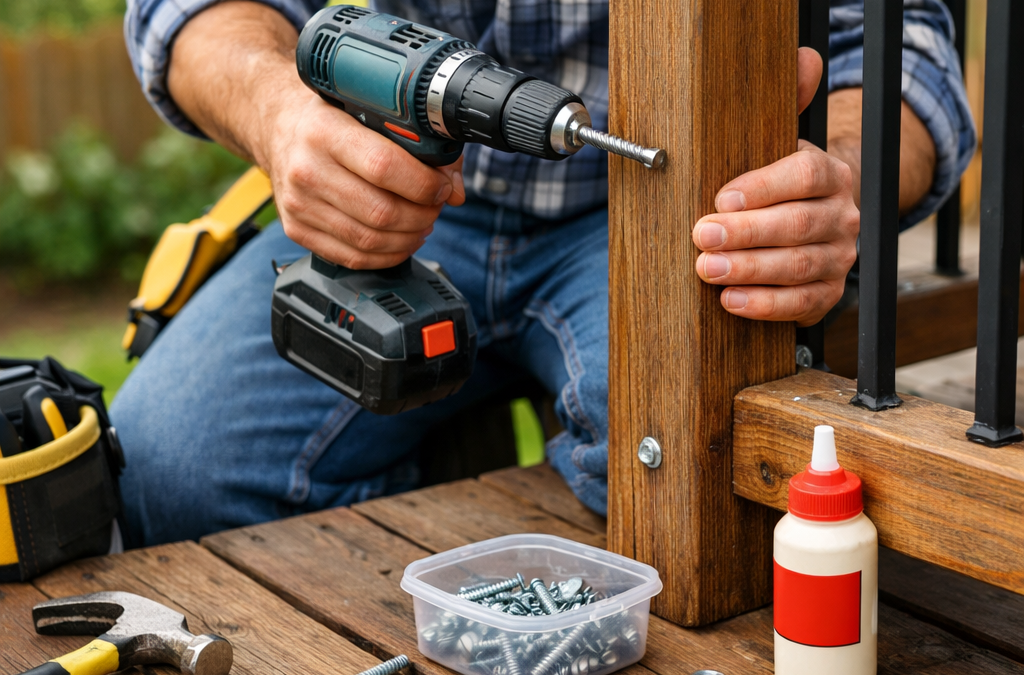
Yes! We all know a deck railing can wobble, and this immediately becomes a safety issue.
Thus, one must never overlook a loose railing since a single push or lean can lead to a fall. Let me tell you that it is not difficult to fix a loose railing, especially when you know what the right steps are.
Why Railings Become Loose
Railings loosen progressively with the lapse of time. In addition to this, the weather also plays a major role. Wood expands and contracts due to rain and heat, and temperature changes. Most of the time, the screws loosen, and the connectors weaken. This happens to moving posts sometimes due to the settling of the ground. The problem can also be covered by wood rot in older decks. Knowing the cause will help you fix it easily.
Check the Railing Thoroughly
Check it out before you start doing any repairs. Gently shake the railing. Then, see which part moves. Often, the top rail trembles. The post is occasionally too wobbly. Screws are, in most instances, absent entirely. What you need to do initially is look for signs of rot. Molding or rotting wood has to be changed. Preliminary inspection is more efficient in time and safer for repair.
Tighten All Connections
Loose railings are most of the time due to screws that have worked out. Start by tightening them. Next, install exterior-grade screws or building screws. These are superior to conventional ones.
In case the holes that were there previously are peeled, the screw that will follow will not be very well held. Then stuff the dowel and wood glue in that hole. Let it dry. Then drill and screw-in again. This strengthens the connection.
Reinforce with Brackets
When the wobble persists, strengthen the railing. The railing has metal brackets that support and stabilize the railing and the posts. Use outdoor brackets that do not rust.
Install it on the lower portion of the railing to make it look cleaner. As soon as it is in place, you will see that the stability is enhanced at a glance.
Fix Wobbly Posts
Do you know? The trouble is sometimes with the posts, and not the railing. So, when a post moves, then the whole construction becomes shaky and unreliable. It is necessary to check the base. Posts are to be firmly seated in brackets or bolted to the frame.
Tighten loose bolts. In case the post is rotten, replace the post immediately. A strong post means a strong railing.
Add Blocking for Extra Strength
If the railing still feels weak, add blocking. Blocking is a piece of wood installed between joists under the deck. It gives the post extra support. This method is especially useful on older decks where the original frame has shifted.
It prevents sway and keeps the railing firm, even during strong pressure.
Seal the Wood After Repairs
Moisture is often behind loose railings. So sealing the repaired areas helps protect the wood. Use an outdoor wood sealer. Make sure the surface is dry before applying it. Sealing prevents rot and reduces future loosening.
Test the Railing
Once all repairs are complete, test the railing. Push it gently from different angles. Moreover, walk along the deck and hold onto the railing as you move. A safe railing should not wobble, tilt, or feel weak. Furthermore, the testing ensures that everything is solid and ready to use again.
Final Suggestion
There should never be any delay in loose railings. Moreover, fixing them fast keeps everyone who uses your deck. Close attention and powerful fasteners, with some additions, make your railing solid once again. Maintaining it in good condition gives you the comfort of having a safe time in and out of the door.
For more assistance, contact Decks N Stones, who are ready to assist you 24/7.