
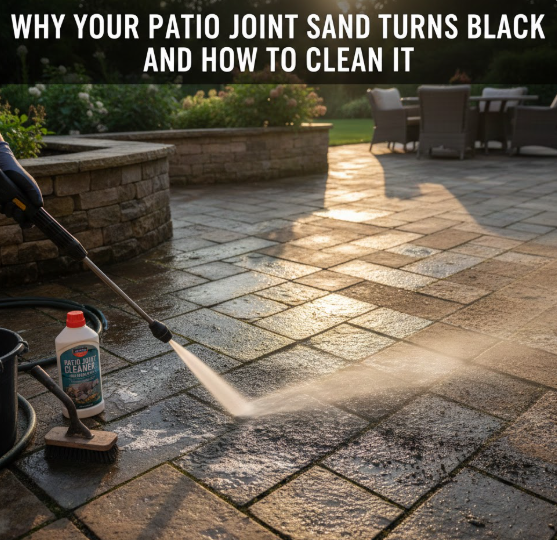
Your patio did not get old in a night, but such joints are now as time-stained as though they were stained. In fact, blackened joint sand is no secret- it is a warning. It informs you that it is moist, shady, and unwanted. Although it is just a superficial issue, it appears that you can be harboring more serious problems that will lead to your patio wearing out more quickly.
The Reason Patio Joint Sand Turns Black
Organic growth is the most common cause of black joint sand. Patios are damp areas, particularly in the shady and low-draining areas. Algae, mould, and mildew may develop when moisture remains. These are creatures that lie in the deep joint sand and slowly discolour it inwardly.
There are also dirt and debris that are airborne and contribute to the problem. The joints accumulate dust, pollen, and soil particles over time. When combined with water, they create a fatty layer upon which biological growth thrives. This accumulation is deep in the sand, unlike surface stains and thus it is not solved by merely washing it away.
The other element is the sand. Polymer-free sand is used in older patios, and it can easily be washed and also remains wet. When the sand disintegrates, it becomes porous and retains moisture and organic material within it.
Why Pressure Washing in Itself is not the Answer
Pressure washing may appear to be a fast solution, but it may damage the patio. It fades off the surface tint temporarily, in the process, fades off the joint sand, leaving gaps. Those cracks allow accumulation of more water, and the algae grows faster and may dislodge or move the pavers.
Pressure washing also does not address the root cause. The spores that render the sand black, remain below ground. Unless you treat them, the dark stain tends to reappear in a few weeks, and even darker than it was the first time.
The Way Moisture and Shade Complicate the Issue.
Patios next to trees or fences and neighboring buildings receive reduced direct sunshine. A smaller sun also slows down the drying of the sand and leaves it longer in the damp stage. Stability of moisture accompanied by shade makes the perfect environment where algae and mold develop.
Poor drainage makes it worse. When the water remains on or beneath the patio following the rainfall, it continues to encourage the organic growth. With time, this collected moisture makes the sand weak and predisposes it to black stains.
Cleaning the Sand on the Blackened Joints.
It starts with the elimination of the biological growth, not only the color. Clean with a solution that will get rid of algae and mold. Such types of treatments enter the joint sand and degrade the organic matter there, not merely heap it over.
Rinse with a slight amount of force, rather than high force, after the application of the cleaner. Allow the solution to take its time in order to kill the spores. When a spot is highly contaminated, you might require a second application to get permanent results.
New sand should be added when the joints are dry. Re-sanding is done to stabilize and prevent water pooling. A lot of homeowners are replacing the traditional sand with polymeric sand, which hardens when used and withstands moisture and plants better than the traditional sand.
Prevention of Black Joint Sand Relapse.
Moisture control is the initial step in the prevention of the problem. Enhance the drainage of the area surrounding the patio by either grading the ground or adding channels. This reduces staining that occurs in the future. Clip hanging plants off to enable the surface to dry quicker than usual after falling.
Routine servicing is also important. Light cleaning on a seasonal basis prevents the accumulation of debris in the joints. When it is appropriate, pavers can be sealed to minimize the absorption of moisture and inhibit the growth.
The most important thing is to deal with the initial signs of discoloration. Black joint sand does not seem to occur at night; if you spot it at an early stage, you are likely to save a massive clean-up or mend later.
Key Takeaways
- Black joint sand is caused by moisture and organic growth.
- Shade and poor drainage make discoloration worse.
- Pressure washing alone is not a long-term solution.
- Patio-safe cleaners remove growth at the source.
- Re-sanding joints restores stability and protection.
- Polymeric sand helps prevent future blackening.
- Moisture control is key to long-term results.
A Little Thing That Makes a Big Difference
Blackened joint sand may be small but it can severely damage the appearance and existence of your patio. Being able to understand the cause and not only the result of its occurrence will be able to restore the look and the functionality of your outdoor setting. With the appropriate steps, you can avoid those dark lines and secure the future of your patio.
For further assistance, call Decks N’Stones today, and we will restore your patio with perfection.