
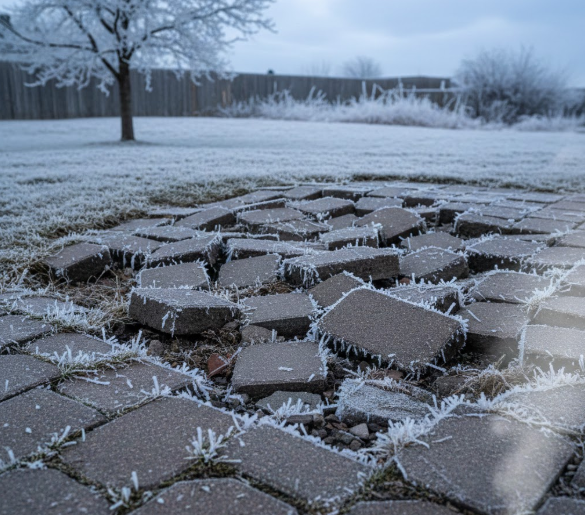
He didn’t imagine it!
Last summer, Mark’s paver patio was perfectly level, the kind of space where coffee tasted better and evenings lasted longer.
But… after one harsh winter, though, the corners lifted, gaps appeared, and a once-polished patio turned into an obstacle course. No earthquakes. No heavy equipment. Just frost doing what frost does best.
We don’t want you to suffer like Mark. Frost heave is a silent killer of several patios, and you can prevent it on your own. When you are aware of its occurrence and the methods to avoid it, you have secured your area outside before winter rules the world.
What is Frost Heave, and why does it attack Paver Patios?
Frost heave occurs when wet soil is frozen, and then as the soil freezes, it grows and causes the ground to move up. When it melts, the soil falls again. The effect of this repeated lift and drop is that pavers slide, tilt or strain over time.
Paver patios are particularly vulnerable since they are placed close to the surface and rely on the underlying feature. When the bottom or soil contains excessive water, or it is not packed firmly, frost will readily cause destruction.
Bad Base Preparation: The Bane of most things.
The power of a patio is based on its foundation. Thus, a shallow or poorly packed base is the most prevalent cause of frost heave. When the ground under it is too near the frost-line, it will be frozen and thawed.
A good patio requires a deep bed of pressed stone. This allows the water to drain off rather than to freeze beneath the pavements. Omitting or shortcutting this stage nearly ensures motion following the initial severe winter.
Drainage Is Non-Negotiable
The actual cause of frost heave is water. When moisture accumulates beneath your patio, it will be frozen by the cold. Poor drainage may be due to flat slopes, clay soil or blocked runoff paths.
To prevent this, the patio should be inclined at a slight angle that would direct the flow of water off the buildings. Permeable materials are to be used, and water must have a distinct exit. Frost cannot cling so strongly when water moves freely.
Use the Right Materials in Cold Weather.
Freeze-thaw cycles do not occur equally with all materials. Others absorb more water and, therefore, are more prone to cracking or moving. High-grade concrete or natural stone pavers are also made to withstand cold weather.
The collaborative material is also important. Polymer sand properly placed holds pavers in position and keeps the water out. Normal sand is able to wash or retain moisture, increasing the chances of movement during winter.
Edge Restraints Hold Everything in Line.
Even a patio properly made may have to shift in the absence of adequate edge restraints. These hold all the pavers in one piece and prevent them from sliding laterally when the ground shifts.
Frost heave picks up pavers and draws them aside with no restraints. In the long run, the lines become bigger, the sides become more depressed, and the patio becomes deformed. Securing the edges might seem to be a small act, but it makes a big difference.
Repairing Preexisting Frost Heave Damages.
You are not doomed as long as frost heave has already started to appear on your patio. Affected pavers may be lifted, the base attached, and the surface reset, without the need to replace the entire patio. However, simply flattening the top without making the base deep or repairing drainage is merely a short-term fix.
Long-term solutions enhance the base and manage the moisture. A professional evaluation would save on time, finances, and disappointment.
Prevention is Cheaper than Cure.
It is far easier and less expensive to prevent frost heave than it is to repair it after it occurs. Adequate excavation, material selection, and intelligent drainage planning might appear as unnecessary actions, but they will make your patio last a lifetime.
We at Decks N’ Stones (USA) believe that outdoor areas must remain hard and upscale. Climate-sensitive patios allow winter to remain a season, not a structural danger.
A patio that survives winter isn’t luck; it’s planning done right. Call us today for professional assistance, and we will be at your doorstep to fix any issues facing your patio.