
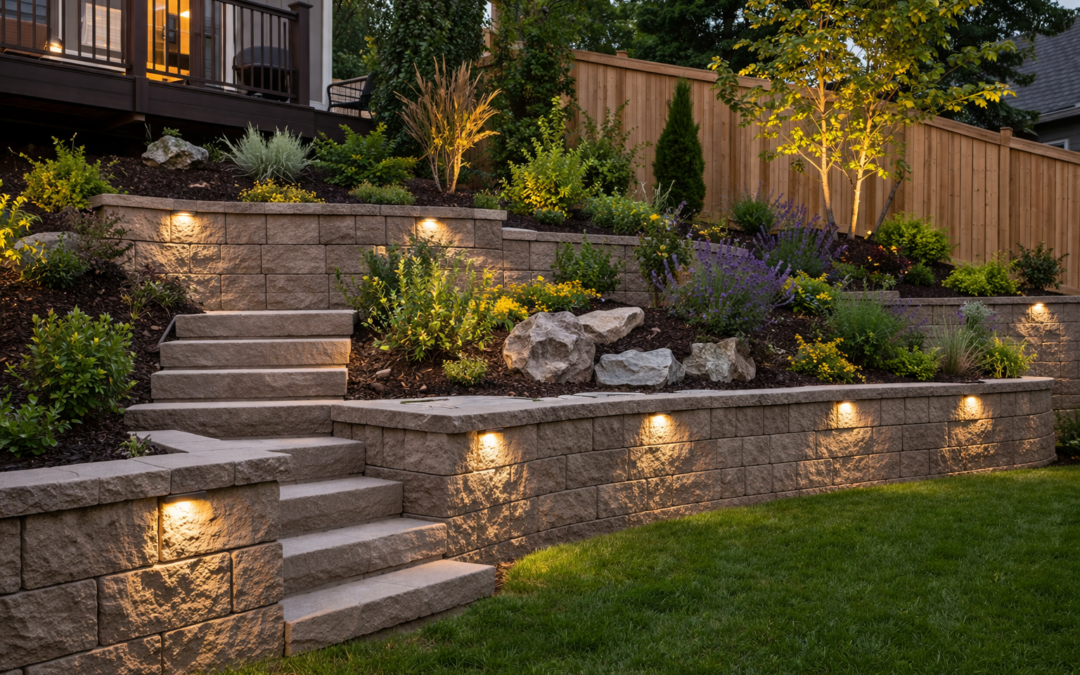
A backyard must be comfortable, practical and secure. Nonetheless, terrestrial inclinations, soil erosion and drainage issues may render outdoor spaces challenging to control. Most of the time, a retaining wall is the best solution. It keeps the soil in place and enhances the outlook and functionality of your lawn.
When you are not aware of whether your backyard needs a retaining wall, then look to these obvious demonstrations. Knowing them can assist you in better landscaping choices and save on your property.
Your Yard Has a Steep Slope
A steep backyard slope is also one of the most frequent reasons why homeowners install retaining walls. Hilly slopes can be seen as a pleasant view, but they can pose practical difficulties. To illustrate, the soil can be pushed down the hill as time progresses, particularly following massive rainfall.
Owing to this, it becomes hard to sustain plants or construct patios on hilly terrain. A retaining wall makes the slope stiffer by keeping the soil in place. The area is less dangerous and more convenient.
Moreover, uneven land can be modified to even areas using retaining walls. This will enable you to incorporate seating space, gardens or walkways which otherwise could not be on a steep surface.
Soil Erosion Is Ruining Your Lawn.
Soil erosion is also another obvious indication that you require a retaining wall. Soil can be washed away in the rain as it pours through your yard. This process eventually results in bare spots, rugged surfaces, and bare roots of plants.
Erosion also ruins the elements of landscaping and the state of your lawn. The problem is which forms a barrier that keeps soil in position.
Since the wall helps in holding the earth behind, it greatly helps to reduce the soil movements. This means that your yard will be steady and your plants will remain safe.
Post-Rain Water Drainage Problems.
Poor drainage may be manifested by standing water or muddy locations. Water can accumulate in some of your yard when it moves down the slopes without being properly controlled. This may destroy grass, soil and even the surrounding buildings.
A retaining wall is capable of directing the water. Most designs have drainage systems that handle excess water. Consequently, there is the diversion of water in a secure way rather than accumulating in undesired places.
A retaining wall can be used when the backyard is usually flooded or has a lot of water after it has rained.
Your Foundation Requires an Overlay.
Occasionally, there is a need to have retaining walls to safeguard the basis of your home. Soil moves or water flows that can occur towards the house may cause pressure to the structure. This pressure can cause cracks or other problems with the foundation over time.
A well-constructed retaining wall serves as a defensive barrier. It diverts the soil flow and water out of the house, which minimizes the chances of structural damage. The solution is particularly useful in households that are constructed along slopes or in high terrain.
You Want to Build Functional Outdoor Spaces.
The retaining walls are practical as well as appealing to the eye. They are placed by many of the homeowners to provide extra usable backyard spaces, which could be raised garden beds, terraces, or sitting areas.
They also put together various ranks of a yard. You can have more than one humpy slope in your backyard, but there will be a number of flat areas to relax or to have fun.
It is due to this that retaining walls are commonly employed in the current landscape design to achieve aesthetics as well as functionality.
Your Landscape Requires Long-Term Stability.
The necessity of a retaining wall may be evident due to repeated landscaping issues. Given that soil continues to move, plants cannot grow easily, or there is still drainage problems, then it may require long term solution.
A strong retaining wall is a permanent stabilizer of your landscape. It enhances the framework of your yard and can be used to hold on to its shape as time goes by.
In addition, it minimises maintenance issues brought about by the movement of soil and water erosion. This makes your outer area appealing and manageable.
Final Thoughts
Soil erosion, drainage problems and steep slopes are some of the backyard problems that can soon convert a nice yard to a frustrating one. Luckily, retaining wall could address most of these issues and improve the appearance of your outdoors area.
When properly installed and designed, retaining walls can offer stability, enhance drainage, and turn your yard into a more useful space. In case your backyard reflects the traces of land erosion, uneven soil, or pooling water, it can be the time to think about adding the retaining wall that will stabilize and reshape the landscape.
Call us today and our professional team at Decks N’Stones will assist you with the construction of a retaining wall.